
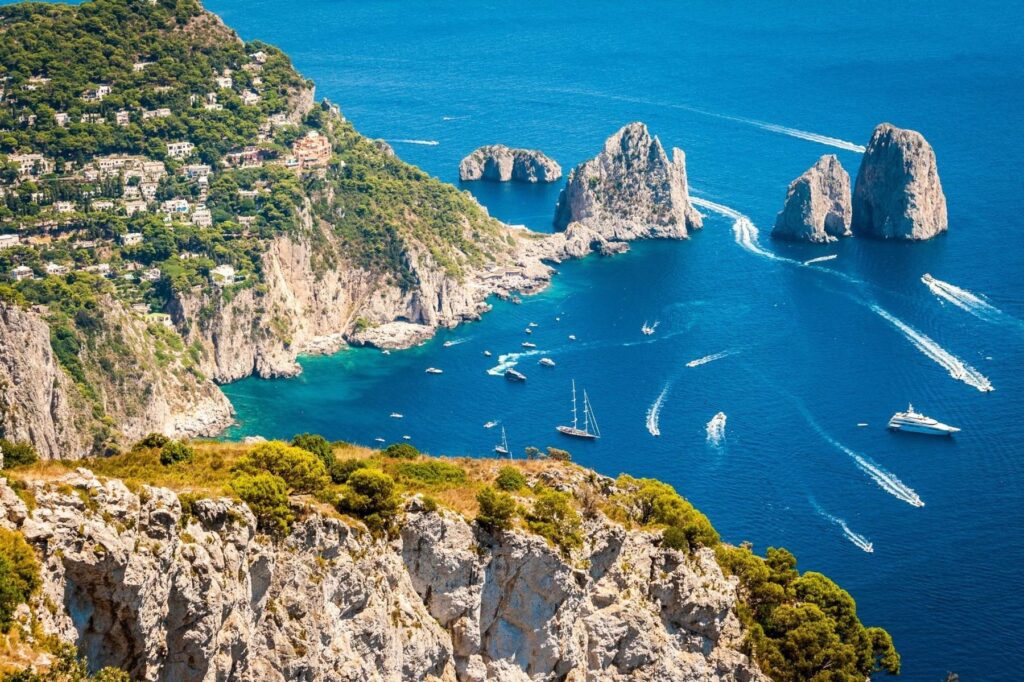
The Amalfi Coast is mostly made of inlets the coast road never reaches: small coves of pale shingle where the water shifts colour by the hour, and where, in the right months, you can linger for a long time without crossing paths with anyone. The point is that many of these coves have no path at all, or have one that means a descent of hundreds of steps cut into the rock.
Santa Croce beach: the cove reachable only by boat
Just west of Amalfi, Santa Croce is a small pebble beach hemmed in by cliffs, and you reach it only from the sea: no road, no path, just the boatmen's water taxi from Amalfi harbour. That isolation is what makes it special. The water is among the clearest along the whole stretch, the rocky seabed is ideal for snorkelling, and a couple of long-standing restaurants cling to the cliff above the water for a lunch stop. It's the cove that explains, better than any other, why the boat changes everything: without one, you simply don't get there.
Duoglio beach: clear water a step from Amalfi
About a kilometre from the centre of Amalfi, Duoglio is separated from the coast road by a stairway of four hundred steps — which is why almost everyone arrives by sea, on the water taxi from the harbour. The water is crystal clear, and the rocky bottom makes it one of the best spots on the coast for snorkelling. There's a small beach club with a restaurant and a stretch of free beach; the sun leaves by mid-afternoon, so morning is the time to come.
Fiordo di Furore: how to see it from the water
Strictly speaking it isn't a cove but a cleft in the rock, where the Schiato stream meets the sea beneath a bridge some thirty metres high, from which cliff divers leap every summer. From the water, the fjord is best admired from a little way out: the mouth is narrow and sheltered, and for safety reasons boats don't go inside. But it's from the sea that you see it at its true scale, with the walls rising almost sheer and the crescent of beach just visible at the far end. It's worth knowing what you're looking at. The fishing village set into the rock dates to the 17th century, and one of the little houses belonged to Anna Magnani: this is where she lived her affair with Roberto Rossellini, who filmed part of *L'Amore* here in 1948. In the 1980s the village — nicknamed "the town that isn't there" because it's almost invisible from the road — was decorated with murals by various artists. The fjord isn't just a photo opportunity: it's a piece of the coast's history, and of cinema's.
Marina di Praia: the historic landing among the cliffs
At Praiano, Marina di Praia is a narrow strip of beach wedged between two rock walls, at the mouth of a ravine. For centuries it was the area's only landing point, and today it remains the natural harbour from which excursions set out towards the nearby sea caves and the Gavitella. Unlike almost the whole coast, it faces west: the sun stays late, and it's one of the few spots from which you can watch the sun set over the sea.
Conca dei Marini and the Emerald Grotto by boat
Conca dei Marini is one of the most photogenic villages on the coast, and below the town opens the Emerald Grotto: a karst cavity where light, filtering up through an underwater opening, turns the water an unnatural green. You can reach it from land by lift, but arriving from the sea — and then moving on to the nearby Conca bay, among rock arches and shallow water — is the way this stretch is meant to be experienced. Inside, you move by rowing boat, in silence, among stalactites mirrored in the green water.
La costiera amalfitana è fatta soprattutto di insenature che la strada statale non tocca: calette di ghiaia chiara dove l'acqua cambia colore a ogni ora e dove, nei mesi giusti, si può restare a lungo senza incrociare nessuno. E molte di queste cale non hanno un sentiero per essere raggiunte via terra.
Spiaggia di Santa Croce: la cala raggiungibile solo in barca
Poco a ovest di Amalfi, Santa Croce è una piccola spiaggia di sassi chiusa tra le scogliere, e si raggiunge solo dal mare: niente strada, niente sentiero, solo il taxi-boat dei battellieri che parte dal porto di Amalfi. È questo isolamento a renderla speciale. L'acqua è tra le più limpide di tutto il tratto, il fondale roccioso è perfetto per lo snorkeling, e a picco sull'acqua resistono un paio di ristoranti storici dove fermarsi a pranzo. È la cala che spiega meglio di ogni altra perché la barca cambia tutto: senza, semplicemente non ci arrivi.
Spiaggia del Duoglio: acqua limpida a un passo da Amalfi
A circa un chilometro dal centro di Amalfi, il Duoglio è separato dalla statale da una scalinata di quattrocento gradini — motivo per cui quasi tutti ci arrivano via mare, col taxi-boat dal porto. L'acqua è cristallina e il fondale roccioso lo rende uno dei punti migliori della costa per lo snorkeling. C'è un piccolo stabilimento con ristorante e un tratto di spiaggia libera; il sole se ne va a metà pomeriggio, quindi il mattino è l'orario giusto.
Fiordo di Furore: come vederlo dal mare
Tecnicamente non è una cala ma una spaccatura nella roccia, dove il torrente Schiato incontra il mare sotto un ponte alto una trentina di metri da cui ogni estate si tuffano gli atleti del cliff diving. Dall'acqua il fiordo va ammirato dal largo: l'imboccatura è stretta e protetta, e per ragioni di sicurezza non ci si addentra in barca. Ma è proprio dal mare che lo vedi nella sua dimensione reale, con le pareti che salgono quasi a picco e la spiaggetta a mezzaluna che si intravede sul fondo. Vale la pena sapere cosa stai guardando. Il borgo di pescatori incastonato nella roccia è seicentesco, e una delle casette apparteneva ad Anna Magnani: qui visse la sua storia con Roberto Rossellini, che a Furore girò parte del film *L'Amore* nel 1948. Negli anni Ottanta il paese — soprannominato "il paese che non c'è" perché quasi invisibile dalla strada — è stato decorato con murales d'autore. Il fiordo non è solo uno scorcio fotografico: è un pezzo di storia del cinema e della costa.
Marina di Praia: l'approdo storico tra le falesie
A Praiano, Marina di Praia è una stretta lingua di spiaggia incassata tra due pareti di roccia, allo sbocco di una gola. È stata per secoli l'unico punto d'approdo della zona, e oggi resta il porto naturale da cui partono le escursioni verso le grotte marine dei dintorni e verso la Gavitella. A differenza di quasi tutta la costa, è esposta a ovest: il sole resta fino a tardi, ed è uno dei pochi punti da cui si vede il tramonto sul mare.
Conca dei Marini e la Grotta dello Smeraldo in barca
Conca dei Marini è uno dei borghi più fotogenici della costiera, e sotto il paese si apre la Grotta dello Smeraldo: una cavità carsica dove la luce, filtrando da una fenditura sottomarina, tinge l'acqua di un verde innaturale. La si raggiunge anche via terra con un ascensore, ma arrivarci dal mare — e poi spostarsi verso la vicina baia di Conca, tra archi di roccia e fondali bassi — è il modo in cui questo tratto è fatto per essere vissuto. All'interno si naviga a remi, in silenzio, tra stalattiti che si riflettono nell'acqua verde.
Join Us for the 2026 Season
Sea Sons is now accepting reservations for the 2026 Mediterranean charter season. Contact our team to discuss your ideal itinerary.
Request Availability